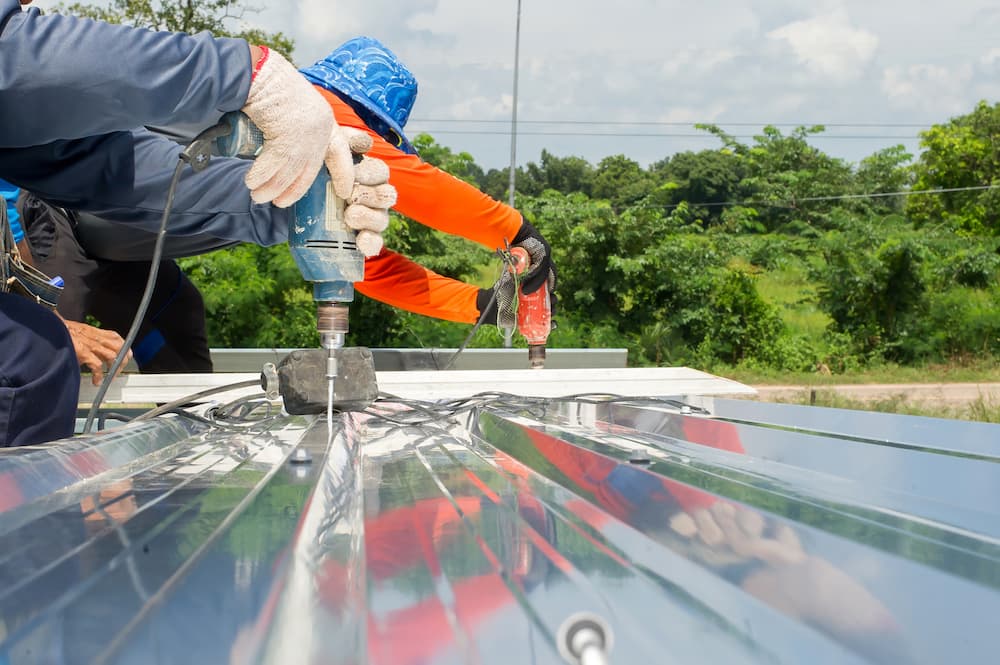
Recently, National Roofing installed two solar arrays on two different Smith’s grocery stores here in Albuquerque. This is part of a pilot program for Kroger, through which they hope to ascertain the cost effectiveness of solar power on their stores, and if the dollar signs work out, this program will likely be expanded.
That’s great, and good for Kroger for showing some social responsibility. Alternative energy is a good thing unless you happen to be some sort of oil baron, and if you are an oil baron, well, you’re probably part of the problem to begin with.
All of this aside, the two arrays were more or less identical across both of these grocery stores, but our profit certainly wasn’t. On one of these jobs, we lost money, while on the other we came in under budget. Remember, these two jobs were more or less identical in terms of the product we were installing, but that couldn’t have been farther from the truth when we finally did the accounting for each.
Everyone wants to put solar panels on the roof. They’re large, bulky, kind of ugly even, and so it makes sense to get them out of the way by putting them up where nobody goes, on to a roof.
The big question is where you put them on the roof. On one of these grocery stores, we put the solar panels parallel to the skylights. It made the system look a little cleaner, but it caused us to have to do twice as much preparation of the roof.
Single-ply roofs, like TPO and EPDM, are made up of large sheets of material that are either welded or adhered together depending on assembly. Where these sheets are welded or adhered together a seam is created. These seams are where these roofs can be the most fragile, and thus care must be taken to protect these areas.
On one of these grocery stores, we managed to set up the racks for the solar panels so that they sat in between the seams. On the other, the racks hit almost every seam, and thus each seam had to be protected before we could put the racks down.
So it was the same assembly, but based on how we laid out the racking system, the cost of each was massively different. This is likely to be true of every roof mounted solar system, where it gets placed on the roof will have a dramatic effect on what the final cost of the installation is.
Since we at National Roofing like installing solar projects, and we also like saving our customers money where it is responsible to do so (i.e. not horribly dangerous), if you are thinking of starting a solar project, give us a call. At a minimum, we can provide information on how the solar system will be best integrated into the roofing assembly, and we will be happy to do so.
National Roofing is Thinking on Top – so you don’t have to worry about it.
Read more over at Solar Novus.